

Get the free Money Without the Panic Planner
Know what you have, what you owe and what your future might need, all in one calm place. No judgement, complicated spreadsheets or expectation that you suddenly develop an enthusiasm for pensions.
Enter your details and I’ll send the planner straight to your inbox.
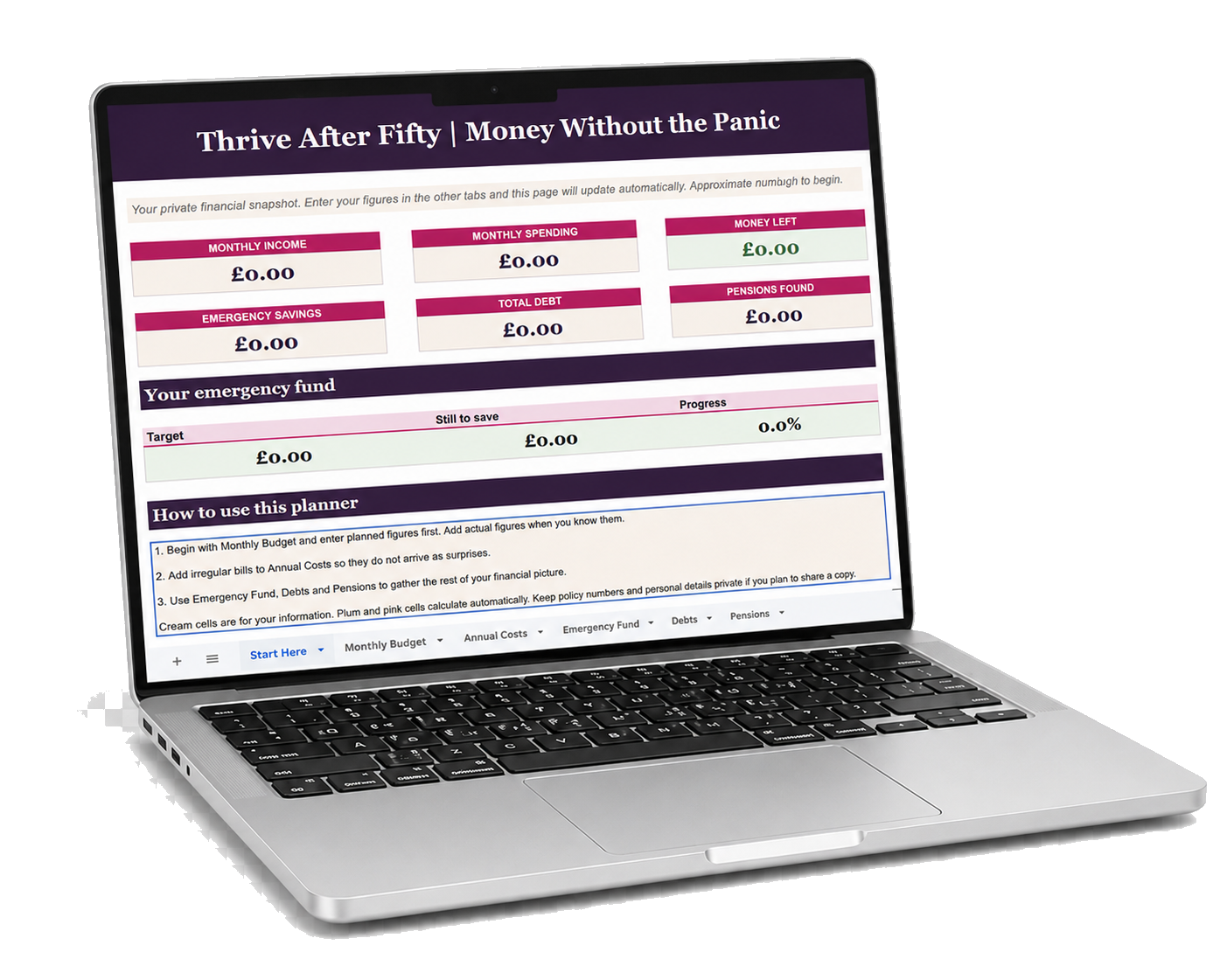
Money Without the Panic
You don’t need to become a financial expert. You just need to know what you have, what you owe and what your future might need.
This is a place to open the envelopes, find the pensions, understand the numbers and make decisions from facts instead of fear. Start where you are, take it one step at a time and build a financial life that gives you more independence, safety and choice.
Start With What You Know
The first step is not making a budget, choosing an investment or working out exactly when you can retire. It is simply understanding where you are now.
Set aside an hour, make a cup of tea and gather the information you already have. Use online banking, recent statements and payslips. Write the numbers down without judging them or trying to fix anything yet.
Your monthly income
Include your salary, pension income, benefits, maintenance payments, rental income and any regular money coming in.
Your essential spending
Start with housing, household bills, food, transport, insurance and minimum debt payments. These are the costs that keep your life running.
Your debts
List credit cards, loans, overdrafts, finance agreements and anything else you owe. Record the balance, interest rate and monthly payment if you can find them.
Your savings
Include current accounts, savings accounts, ISAs, Premium Bonds and any other money you could access.
Your pensions
Write down every workplace and personal pension you know about, even if you do not yet know what each one is worth. We will deal with forgotten pensions next.
This is a snapshot, not a judgement. You may discover that things are better than you feared, or that something needs attention. Either way, knowing gives you somewhere to begin.


Find What You Have
You may have more money set aside for your future than you realise. Pensions are easy to lose track of when you change jobs, move home or spend years concentrating on everything happening now.
Start by writing down every employer you have worked for and any personal pensions you remember opening. Look through old emails, payslips, paperwork and bank statements for provider names or pension contributions.
Find old workplace pensions
If you remember the employer but not the pension provider, use the government’s free Pension Tracing Service. It provides contact details for pension schemes so you can contact the provider yourself. It will not tell you whether you have a pension or how much it is worth.
When you contact a provider, ask for the current value, the type of pension, your expected retirement date and details of any guarantees or benefits attached to it.
Check the pensions you already know about
Sign in to each provider’s online account and download the latest statement. Check that your name, address, email and nominated beneficiaries are up to date.
Keep a note of the provider, policy number, current value and contact details. You are gathering information at this stage, not deciding whether to move or combine anything.
Check your State Pension
Your State Pension may form an important part of your retirement income. The official State Pension forecast shows how much you may receive, when you can claim it and whether you may be able to increase it.
Save a copy of the forecast alongside your other pension information.
Put everything in one place
Create one folder for your pension statements, forecasts and contact details. It can be a physical folder, a secure digital folder or both. The system does not need to be beautiful. It simply needs to help you find the information again.
Finding your pensions will not answer every question about retirement, but it replaces a frightening blank space with real numbers. That is progress.
What Does Your Future Need?
Retirement can feel frightening when it exists as one enormous unknown. It becomes easier to think about when you stop asking, “Will I have enough?” and start asking, “What will my life actually cost?”
You do not need one perfect retirement figure today. Begin by thinking about the life you want, the costs that are likely to remain and the income you may have available.
Where will you live?
Think about whether you expect to rent, own your home, pay a mortgage or move somewhere different. Housing is likely to be one of your largest costs, so it needs to be part of the plan.
What will everyday life cost?
Consider food, household bills, transport, insurance, clothing, health costs and the ordinary things that keep life comfortable. Use what you spend now as a starting point.
What do you want life to include?
Retirement is not only about paying bills. Make room for travel, hobbies, socialising, family, eating out and the things that make your life feel like yours.
When might work change?
You may want to stop working completely, reduce your hours, change careers or continue with work you enjoy. Look at more than one possible age rather than treating retirement as a single fixed date.
Once you have a rough idea of what your future may cost, compare it with the pensions, savings and State Pension you have found. You may see a gap, but you may also discover options you had not considered.
The aim is not to predict every detail. It is to replace a vague fear with a few realistic possibilities.


Build Some Breathing Room
Emergency savings are not about reaching one perfect figure. They are about creating enough space between an unexpected expense and a financial crisis.
Your first goal might be enough to cover a car repair, a broken appliance or an urgent journey. Once you have that, you can work towards one month of essential expenses and build gradually from there.
A common guide is three to six months of essential spending, but that will not be realistic or necessary for everyone. Your target should reflect your income, housing, responsibilities, health and how secure your work is.
Keep it accessible
Emergency money should be somewhere safe and easy to reach. Keeping it in a separate account can prevent it from disappearing into ordinary spending.
Make saving automatic
Choose an amount that is manageable and move it shortly after payday. A small regular payment is more useful than an ambitious plan you cannot maintain.
Decide what counts as an emergency
Job loss, urgent repairs, unexpected health costs and essential travel may all qualify. A holiday, a sale or an impulsive purchase probably does not. Decide your rules before you need the money.
Balance savings and debt
If you have expensive debt, deciding whether to save or repay it first can be complicated. Keep making required payments and consider getting free debt guidance before moving large amounts of money.
MoneyHelper’s free Savings Calculator can help you set a target and work out what you could save regularly.
Your safety fund does not need to impress anybody. It simply needs to make the next unexpected moment easier to handle.
A Note about Money After Divorce
Divorce changes more than your relationship. It can affect your income, home, pensions, debts, insurance and the people who would receive your money if you died. Once the immediate upheaval has passed, it is worth checking that your financial life now reflects the life you are actually living.
Separate your everyday money
Make sure your income is paid into an account you control. Review joint accounts, credit cards, loans, household bills and direct debits. Contact the relevant providers before closing or changing anything, particularly where money or debt is held jointly.
With a joint loan, both people can remain responsible for the full debt, not simply half. MoneyHelper has guidance on protecting your finances during divorce.
Check what was included in your settlement
Property and savings may be the most visible assets, but pensions can also be valuable. A court can make a pension sharing order as part of a divorce or the dissolution of a civil partnership.
If you are unsure whether your finances were formally settled, or whether pensions were properly considered, speak to a family solicitor or appropriately qualified financial adviser. The rules differ across the UK, so advice should reflect where you live.
Update the people you have named
Check the beneficiaries or expressions of wish attached to your pensions, workplace benefits and life insurance. Update your will, emergency contacts and any authority your former partner may still have over an account or policy.
Do not assume that divorce automatically updates every nomination. Contact each provider and make the changes directly.
Build around one income
Look again at your monthly spending, emergency savings and future plans. Your new financial life may be different from the one you expected, but it can still be secure, enjoyable and entirely your own.
MoneyHelper’s free Divorce and Money Calculator can help you organise what you have, what you owe and what may need further attention.
You do not have to rebuild everything at once. Start by making sure the money you earn, save and plan for is properly connected to you.

Your Next Three Actions
You do not need to reorganise your entire financial life this weekend. Start with three actions that will give you useful information and a little more control.
Put a date in your calendar to return to your money in one month. Financial confidence grows each time you look, understand something new and take the next sensible step.
Trusted Help
You do not have to understand everything alone. These free and official services can help you find information, understand your options and decide whether you need professional advice.
MoneyHelper
Free, impartial guidance about money, pensions, debt, divorce and retirement.
Pension Tracing Service
Find the contact details for workplace and personal pension schemes you may have lost track of.
State Pension forecast
Check how much State Pension you may receive, when you can claim it and whether you may be able to increase it.
Check your State Pension forecast
Financial Services Register
Before using a financial adviser or financial firm, check that they are authorised by the Financial Conduct Authority.
A note before you act
The information on Thrive After Fifty is intended to help you understand your finances and prepare for informed conversations. It is general guidance, not personalised financial, investment, pension, tax or legal advice.
Your circumstances are unique. Consider speaking to an appropriately qualified and regulated professional before making significant decisions about pensions, investments, debt, divorce settlements or retirement income.